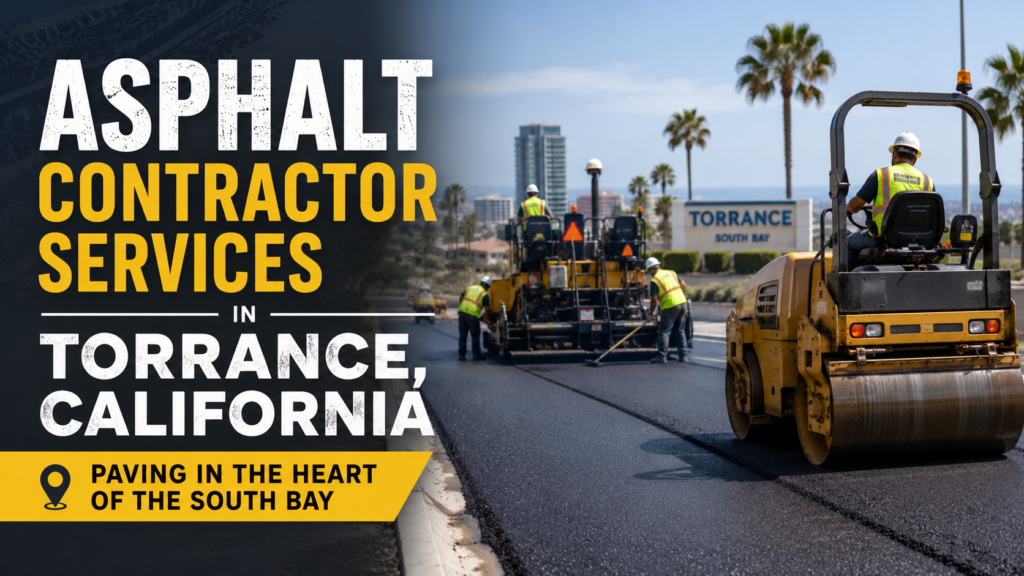
Torrance, California sits in the South Bay region of Los Angeles County a mid-sized city of roughly 150,000 residents bordered by Redondo Beach, Gardena, Carson, and the Palos Verdes Peninsula. Known for its excellent public schools, family-friendly neighborhoods, significant Honda and Toyota corporate presence, and the extensive residential fabric that covers its relatively flat terrain, Torrance generates consistent demand for asphalt paving services across its residential, commercial, and industrial sectors. Understanding what Asphalt Contractors Torrance, how the city’s South Bay coastal climate shapes paving needs, and what distinguishes quality work in this market helps property owners and facility managers make sound decisions about their pavement infrastructure.
The Torrance Paving Landscape
Torrance’s built environment encompasses a diverse range of paving applications. On the residential side, the city’s thousands of single-family homes and apartment complexes generate demand for driveway installation and replacement, a service category that reflects the age of many Torrance neighborhoods where original driveways from the 1950s through 1980s are reaching or exceeding their practical service life. On the commercial side, Torrance’s Del Amo Fashion Center area, the Torrance Airport vicinity, the commercial corridors along Hawthorne Boulevard and Sepulveda Boulevard, and the industrial parks near the 405 and 110 freeways all require consistent parking lot and access road maintenance. The city also has significant HOA-managed communities whose private road networks are maintained through community association budgets.
South Bay Coastal Climate and Its Effect on Asphalt
Torrance’s climate a classic Southern California Mediterranean coastal climate creates specific asphalt aging characteristics that differ from both inland communities and colder-climate regions. Key climate factors affecting asphalt in Torrance:
- Marine layer and moisture: Torrance’s coastal proximity means morning marine layer is a regular feature of the climate for much of the year. This daily moisture condensing on pavement surfaces and then evaporating as the day warms contributes to asphalt binder aging over time. While individually each moisture cycle is minor, the cumulative effect over years is meaningful.
- UV exposure: Despite the marine layer, Torrance receives intense afternoon and evening sun typical of the Los Angeles basin. UV radiation from prolonged sun exposure oxidizes the asphalt binder the petroleum-based material that gives asphalt its flexibility and binds aggregate particles together. As the binder oxidizes, it hardens, becomes brittle, and the surface develops surface cracking and raveling.
- Moderate temperatures: Torrance’s coastal moderation means summer temperatures rarely exceed the 90s, cooler than Inland Empire cities. This reduces the thermal stress from summer softening that affects asphalt in hotter inland areas. However, the combination of daily temperature cycling between morning marine layer cool and afternoon warmth contributes to thermal fatigue in pavement over time.
- No freeze-thaw: Torrance essentially never experiences freezing temperatures. The absence of freeze-thaw cycling means asphalt does not experience one of the most damaging deterioration mechanisms common in colder climates. This somewhat extends service life relative to northern markets, all else being equal.
Residential Asphalt Driveway Services in Torrance
Torrance’s residential paving market is active and driven by the age of the city’s housing stock. Many Torrance homes were built during the postwar suburban development boom of the 1950s and 1960s, meaning that even driveways that have been replaced once since original construction may now be 30 to 40 years old and approaching the end of their second service life.
The standard residential asphalt driveway installation in Torrance includes:
- Site assessment: Evaluating existing driveway condition to determine whether resurfacing (overlay) is appropriate or whether full removal and replacement is needed. In Torrance’s climate, base failure from UV-driven surface deterioration is less common than in freeze-thaw climates, so many surfaces with aged but structurally sound bases are good overlay candidates.
- Excavation and base preparation: For new installation or full replacement, excavating to the required depth, compacting the sub-grade, and installing Class II aggregate base to the appropriate depth.
- Asphalt installation: Applying hot mix asphalt at the specified thickness and compacting with steel drum rollers to achieve the finished surface.
- Sealcoating as first maintenance step: In Torrance’s UV environment, applying sealcoat 6 to 12 months after installation and every 2 to 3 years thereafter is the single most impactful maintenance practice for extending service life.
Commercial Asphalt Maintenance in Torrance
Torrance’s commercial and industrial properties maintain significant parking lot and access road infrastructure that benefits from systematic pavement management. Key commercial asphalt maintenance services in Torrance include:
- Crack sealing: Applying rubberized crack sealant to surface cracks as they develop, preventing moisture infiltration into the base layer particularly important before the rainy season.
- Sealcoating: Protecting the asphalt surface from UV oxidation and moisture intrusion on a 2 to 3 year cycle.
- Slurry seal: A surface treatment that applies a thin layer of fine aggregate and asphalt emulsion over the existing surface, extending service life and restoring a uniform dark appearance. Used in Southern California as an alternative to or complement of traditional sealcoating on larger commercial lots.
- Overlay resurfacing: Applying a new asphalt surface course when the existing surface has deteriorated beyond the effectiveness of maintenance treatments.
- ADA compliance: California Title 24 accessibility requirements apply to commercial parking facilities and must be addressed whenever significant paving work is performed. Accessible space dimensions, slopes, access aisles, and signage must all meet current standards.
Torrance City Permit Requirements
Asphalt paving work in Torrance that involves the public right-of-way the zone between the property line and the street curb, which includes the sidewalk, parkway, and driveway apron in most Torrance neighborhoods requires an encroachment permit from the City of Torrance Public Works Department. Most standard driveway replacements that do not modify the curb cut do not require building permits, but any modification to the curb cut or driveway approach does. California law requires that all contractors performing paving work valued at $500 or more hold a current California Contractors State License Board (CSLB) license Class C-12 (Earthwork and Paving) is the appropriate license for asphalt work.
Asphalt vs. Concrete in Torrance
Torrance property owners sometimes consider concrete as an alternative to asphalt for driveways and parking areas. Both materials have appropriate applications in the South Bay climate. Asphalt’s flexibility and repairability make it well-suited to the soil conditions and seismic environment of Southern California. Concrete’s rigidity and light color can be advantages in specific situations its lighter color reduces heat absorption (a consideration in the Los Angeles urban heat island context) and it does not require periodic sealcoating. However, concrete is significantly more expensive to repair when cracking occurs, and California’s seismic activity means that ground movement over time can crack concrete in ways that are difficult to address without full replacement. For most residential and commercial paving applications in Torrance, asphalt remains the practical and economical standard.
Conclusion
Asphalt contractor services in Torrance serve one of the South Bay’s most established and diverse cities, working across residential driveways, commercial parking lots, HOA community roads, and the industrial access infrastructure that supports Torrance’s manufacturing and commercial base. The South Bay’s coastal climate creates a UV-intensive, moderate-temperature paving environment where consistent sealcoating maintenance is the most important factor in extending asphalt service life. Property owners and facility managers in Torrance who understand these dynamics and who work with CSLB-licensed contractors experienced in South Bay conditions invest in pavement that performs reliably and maintains its appearance through the long Southern California paving season.